
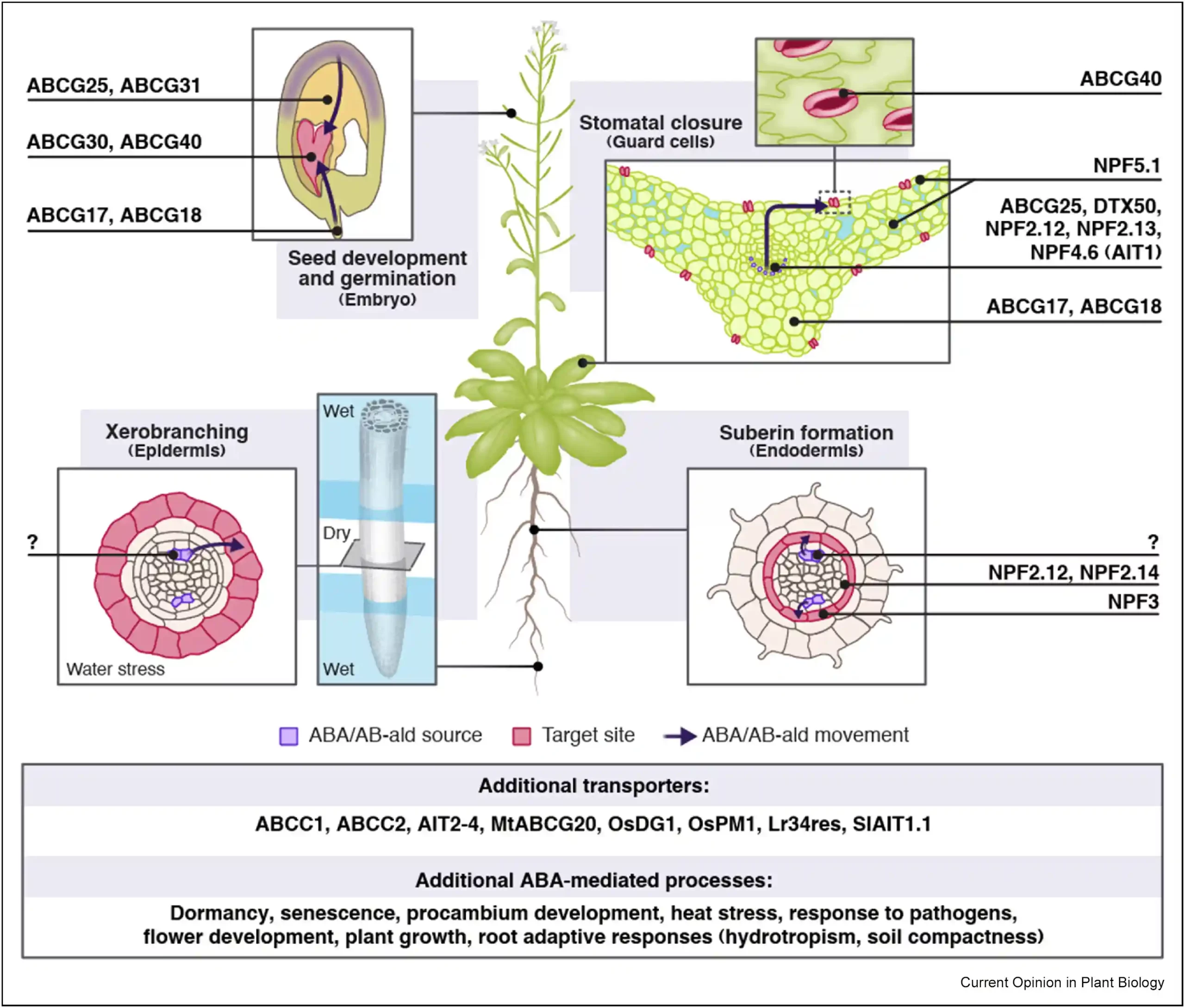
Abscisic acid (ABA) coordinates plant development and water-stress responses through mechanisms that extend beyond local biosynthesis and signaling. Increasing evidence indicates that ABA function depends on the spatial organization of hormone production, transport, catabolism, and perception across tissues. In this review, we highlight how ABA is synthesized mainly in vascular-associated cells and redistributed to distal target sites in leaves, roots, and seeds. We discuss recent findings showing that both ABA and its precursor, abscisic aldehyde, can move between tissues, thereby expanding the routes by which bioactive hormones accumulate. We further consider how transporters, tissue-specific sinks, and environmental cues shape ABA gradients, and highlight outstanding questions regarding the cellular pathways and regulatory mechanisms that determine ABA action in planta.
Anfang, M., & Shani, E. (2026). Abscisic acid activity across tissues: Linking biosynthesis, transport, and target-site action. Current Opinion in Plant Biology, 93, 102932. https://doi.org/10.1016/j.pbi.2026.102932
Image: Tissue-specific ABA responses are shaped by transporter-mediated hormone distribution. ABA and AB-ald (abscisic aldehyde) are delivered from source tissues (purple) to distinct target sites (red), where ABA drives physiological responses, including stomatal closure in guard cells, seed development and germination, suberin formation in the endodermis, and xerobranching in the root epidermis. Directional movement of ABA and its precursor AB-ald between tissues (black arrows) is mediated by multiple ABA delivery mechanisms. The spatial distribution of ABA transporters determines tissue-specific ABA accumulation and responses. ABA, abscisic acid. Credit: Current Opinion in Plant Biology