
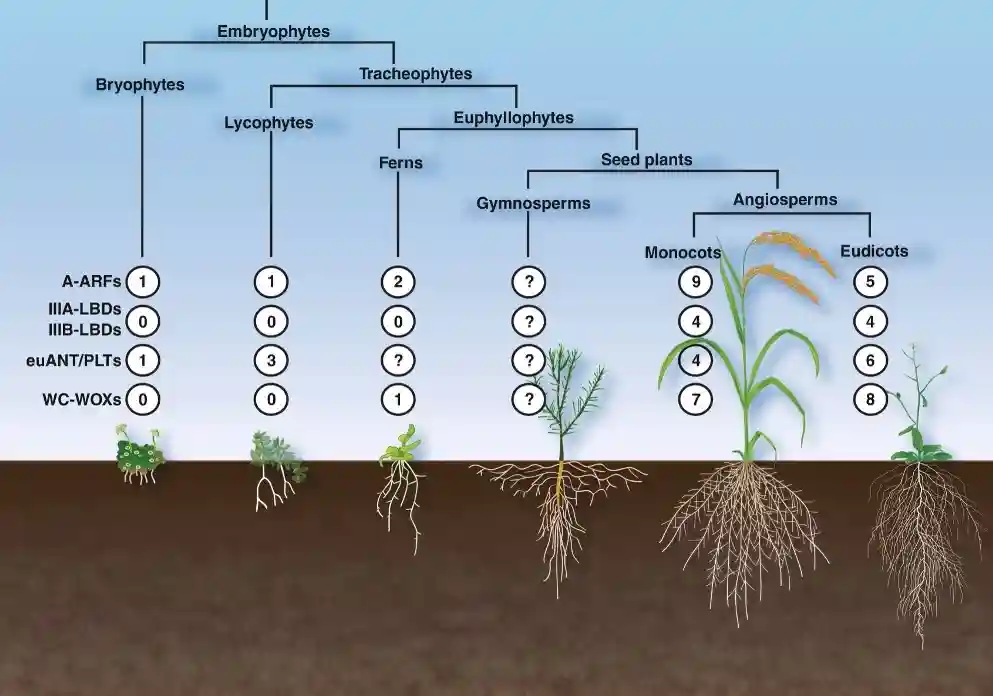
Land plants have successfully colonized every terrestrial environment on Earth, and the evolution of root systems has played a vital role in this success. Root systems perform critical functions ranging from foraging in soil for water and nutrients to providing anchorage for shoot organs. Despite this organ’s importance, the first land plants lacked roots, relying instead on fungal symbioses and root-hair-like rhizoids for foraging and anchorage functions. Root-axis formation in early land plants rapidly led to increased root- (and accompanying shoot-) system complexity. This review will chart the evolution of root systems, from simple bifurcating roots in lycophytes to complex root systems in flowering plants. We will highlight key innovations in root morphology and their regulatory mechanisms. We also discuss how the evolution of novel hormone regulators and gene-regulatory components has enabled root systems to adapt to myriad soil signals and stresses. These adaptive mechanisms have underpinned root plasticity, which has been critical for land plants to adapt to past and present climates and soil conditions. Root-plasticity traits are likely to be critical for maintaining yield stability in a warming world. We conclude by discussing how crop-breeding programs must account for future soil and climate conditions when defining desirable root traits, to ensure the right root system for the right soil and climate.
Lakehal, A., Farrar, E., Pandey, B. K., Sturrock, C. J., Beeckman, T., & Bennett, M. J. (2026). Evolution of root systems in land plants. Current Biology, 36(11), R565-R576. https://doi.org/10.1016/j.cub.2026.04.002
Image: Schematic phylogeny illustrating the evolutionary expansion of key transcription-factor families regulating root branching. Credit: Current Biology