
Gene duplication is pervasive in plant genomes, with 50–90% of genes belonging to families that may exhibit functional redundancy.
In polyploid crops, gene duplication is even more extensive, with the proportion of genes belonging to families often approaching or exceeding 90%.
Redundant gene retention is shaped by duplication mechanisms, molecular functions, and selective constraints.
Genetic redundancy obscures gene function, complicates trait dissection, and hinders crop improvement.
Machine learning–based tools now enable more accurate prediction of redundant gene pairs across plant genomes, but there is a need to incorporate large-scale data to improve predictions.
Single-guide RNA and multiplex CRISPR libraries offer a scalable approach to overcoming redundancy, revealing hidden gene functions, and generating broad datasets that can be fed into future machine learning predictive models.
Berman, A., Zylberberg, I., Mayrose, I., & Shani, E. (2026). Navigating genetic redundancy in plant genomes: insights for research and breeding. Trends in Plant Science. https://doi.org/10.1016/j.tplants.2026.02.004
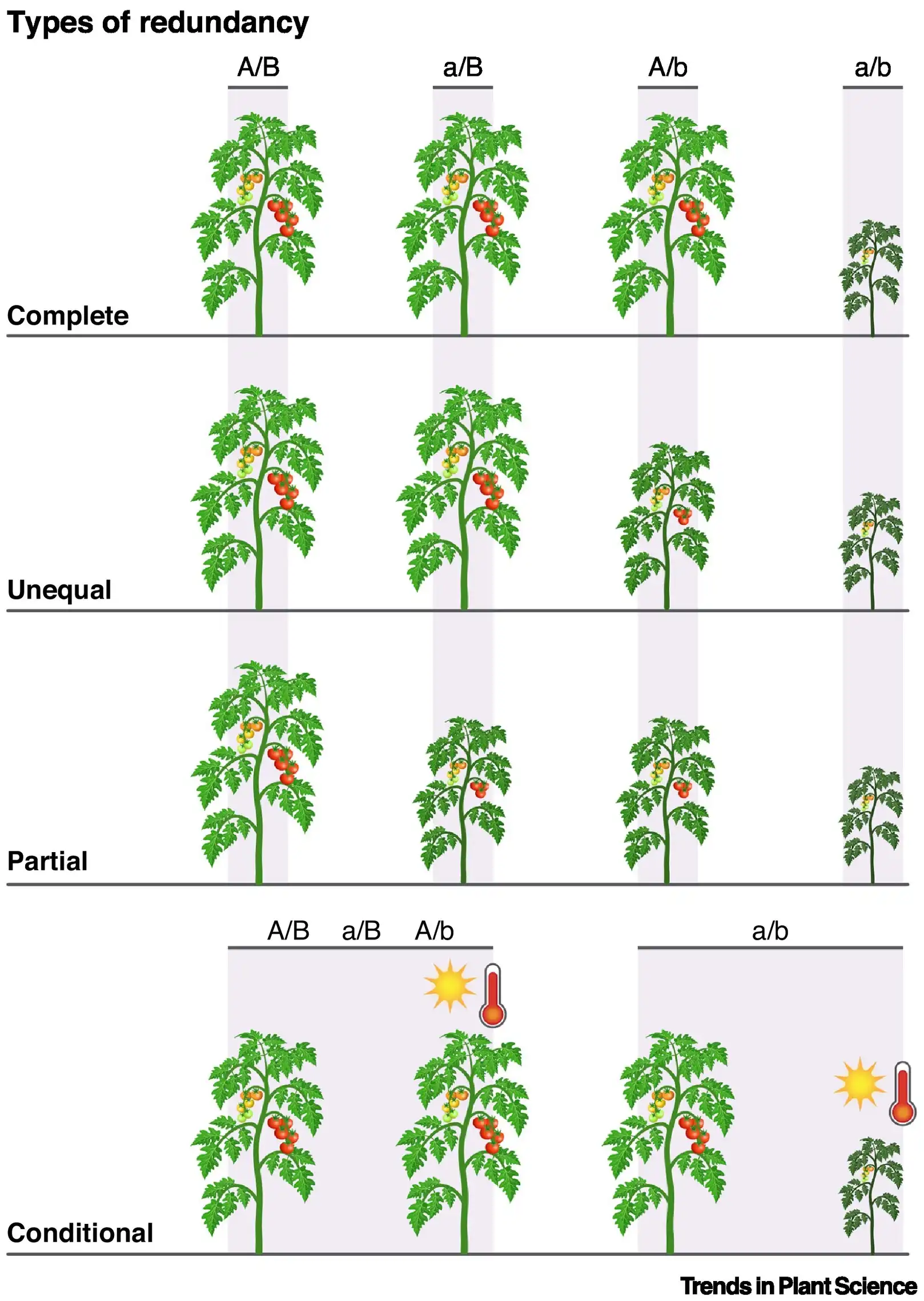
Image: Each panel represents a distinct redundancy scenario, with genotypes annotated as A/B, a/B, A/b, or a/b, where lowercase letters indicate mutated genes. Gray backgrounds highlight the corresponding plant phenotypes for each genotype. In the bottom panel (conditional redundancy), sun and thermometer icons denote specific conditions under which redundancy is revealed. Credit: Trends in Plant Science.