
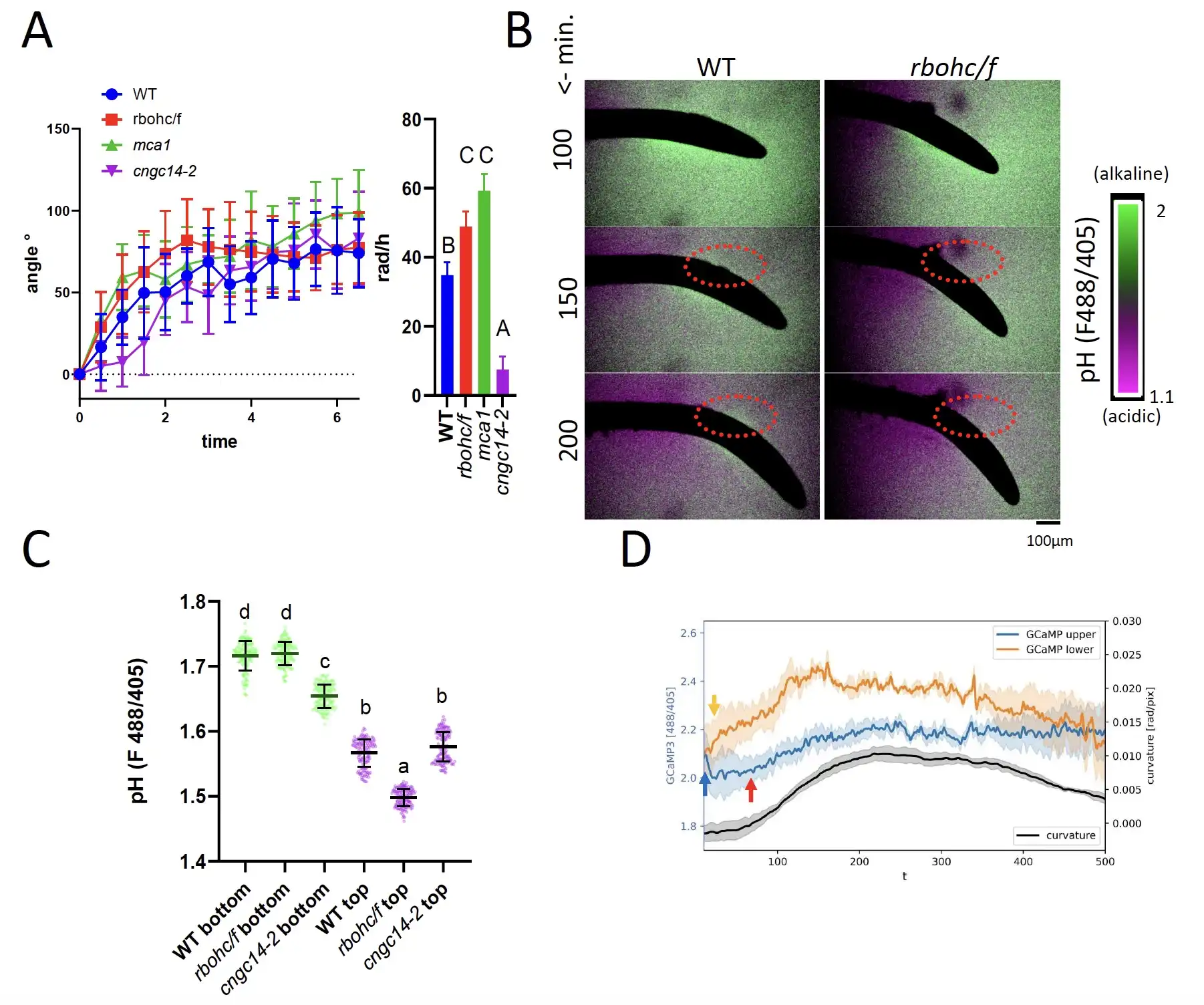
When roots grow through heterogeneous soil, they bend away from obstructions and toward favorable soil pockets. This process involves calcium ion signaling and increases in pH in the apoplastic space around the cell wall. Kulich et al. found that several root stimuli cause increases in calcium ion signals, which are required to activate NADPH oxidases and produce reactive oxygen species. In bending roots, extracellular reactive oxygen species correlate with stiffening of the cell walls and may aid growth through dense soils. The work establishes mechanistic links between common plant signaling components and provides insights into how these affect root growth. —Madeleine Seale
Kulich, I., Vladimirtsev, D., Randuch, M., Gao, S., Citterico, M., Konrad, K. R., … & Friml, J. (2026). Calcium-triggered apoplastic ROS bursts balance gravity and mechanical signals for soil navigation. Science, 392(6795), 296-300.
Image: Gravitropic bending of the rbohc/f mutants and their relative apoplastic pH in the elongation zone. (A) Root gravitropic bending of WT, mca1, cngc14-2, and rbohc/f mutants. Right-expression of bending as linear regression slope after 1 h of bending. Letters denote statistical significance (ANCOVA test of equal slopes p<0.002) (B) Representative images of the apoplastic pH halo in WT and rbohc/f mutants during the course of root gravitropic bending. Red dotted circles highlight the top side of the root with visible alkalinization in WT. (C) Apoplastic pH quantification of the rbohc/f and cngc14-2 mutants at the top and bottom elongation zones 90-160 minutes after rotating the sample by 90°. (one-way ANOVA, p<0.0001)(D) Calcium profile of WT plants during the course of gravitropic bending imaged immediately after rotating the sample, monitored using the GCaMP3.0 fluorescent reporter. The blue arrow marks the initial drop in the calcium signal from the top (upper) side of the root associated with statoliths leaving the membrane in the columella, while the orange arrow marks the increase in the calcium signal at the bottom (lower) side after the statoliths touch the new bottom membrane. The red arrow highlights the increase in the calcium signal at the upper side associated with root bending, which appears at the onset of root bending.