
The brassinosteroid pathway promotes anisotropic cell expansion; however, the effectors in this process remain unclear. Candidates include ARABINOGALACTAN PROTEIN (AGP) genes, which are prominent brassinosteroid-responsive transcriptional targets, and EXORDIUM (EXO)-LIKE (EXL) genes. Here, we examined whether AGP and EXO/EXL genes mediate anisotropic cell expansion.
AGPs are evolutionarily ancient glycoproteins, which are secreted and attached to the plasma membrane. Plant genomes contain dozens of potentially redundant AGP genes. Their roles have mostly been inferred from the phenotypes of beta-glycosyltransferase mutants with impaired AGP glycosylation. Compared with AGPs, little is known about the smaller family of secreted EXO/EXL proteins.
Here, we investigated brassinosteroid-dependent AGP and EXO/EXL gene expression patterns in Arabidopsis roots and created loss-of-function mutants for preponderant genes. Whereas single, double and triple agp mutants appeared wild-type, combinatorial quadruple to sextuple agp2/4/10/11/13/22/24 mutants displayed longer, frequently aberrant root hairs and shorter yet thicker roots. These traits reflect an underlying reduced cellular anisotropy associated with increased organ stiffness, which were also observed in hypocotyls. Combinatorial exo/exl1/2/3/4/5/6/7 sextuple or septuple mutants displayed a qualitatively similar but quantitatively weaker phenotype than combinatorial agp mutants.
Collectively, our data suggest that classical/peptide AGPs and EXO/EXLs promote brassinosteroid-dependent anisotropic growth to different extent.
Novikova, D., Rana, S., Li, K., Diaz-Ardila, H.N., Trozzi, N., Alonso Baez, L., Hamann, T., Majda, M. and Hardtke, C.S. (2026), AGP and EXO-LIKE genes promote brassinosteroid-dependent anisotropic growth. New Phytologist, 250: 2384-2398. https://doi.org/10.1111/nph.71063
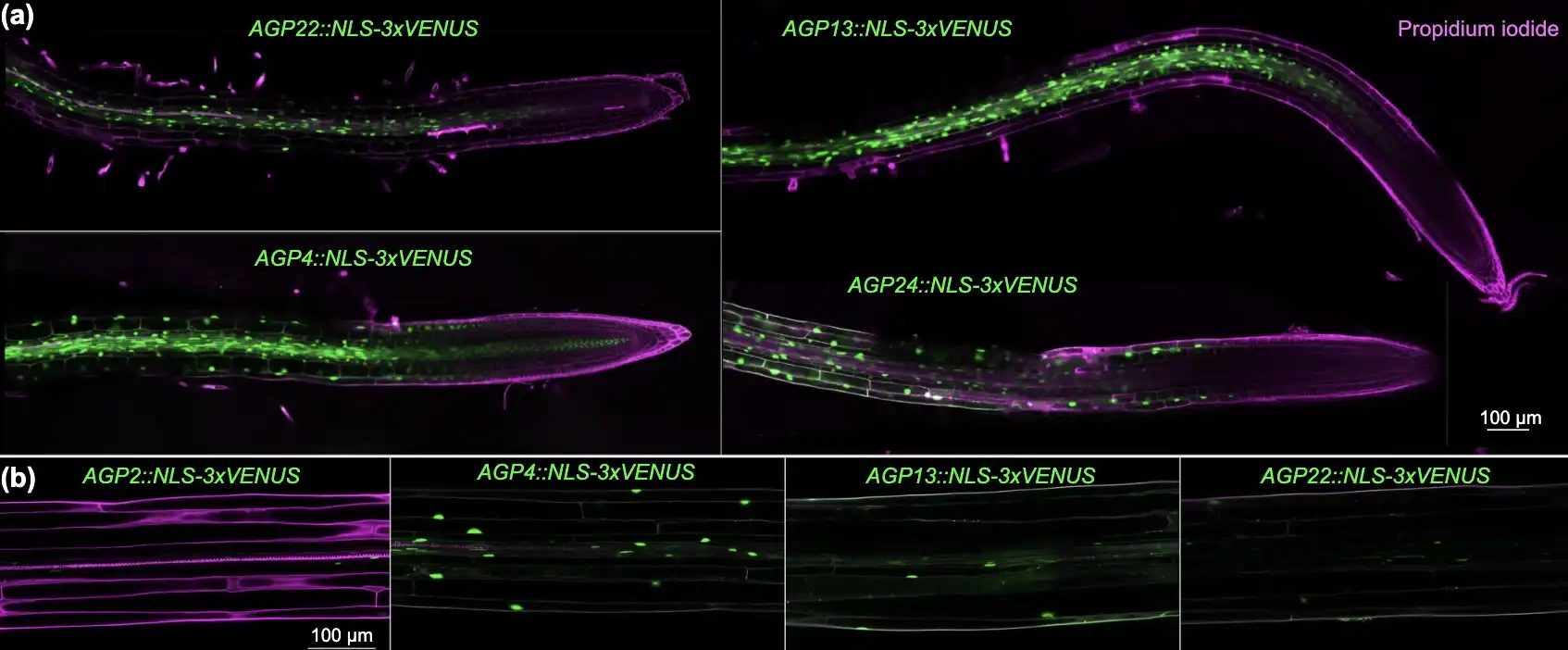
Image: Expression patterns of selected AGP genes. (a, b) Confocal microscopy of root tips (a) and hypocotyls (b) expressing transgenic transcriptional reporters (nuclear localized VENUS protein, green fluorescence) with promoters of the indicated AGP genes in WT (Col-0) background (cells counterstained with propidium iodide, magenta fluorescence). Note the general increase in expression as cells start to expand in roots. Credit: New Phytology